




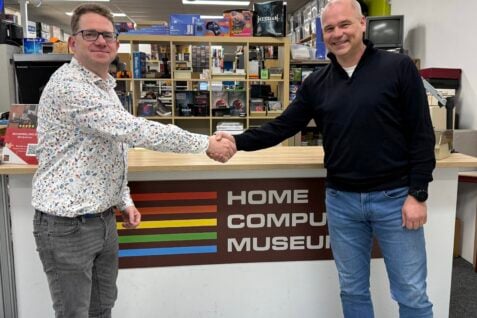
IT Recycling announces a partnership with the HomeComputer Museum in Helmond, the world’s largest museum dedicated to home computers and video game consoles. The partnership brings together two worlds that rarely intersect: the world of responsible IT recycling and that of technological heritage. The result is an approach in which discarded hardware no longer disappears aimlessly but is given a purposeful new life.
The museum that preserves what others forget
The Home Computer Museum in Helmond houses thousands of original devices from the early days of consumer electronics—from the very first home computers to peripherals that shaped an entire generation. The museum attracts thousands of visitors each year and introduces them to the history of the digital revolution in a hands-on, accessible way.
But not every device on display makes it into a showcase. There is more hardware with historical value than there is space to store it. And outside the museum, those devices disappear from view, without a story, without a purpose.
Bart van den Akker, Director of the Home Computer Museum: “The devices on display in our showcase have all had a previous life. By partnering with IT Recycling, we give those stories a place of honor, and we ensure that what cannot be preserved is disposed of in the best possible way.”
What IT Recycling and Preservation Have in Common
At IT Recycling, we process large volumes of business IT hardware every year, ranging from laptops and servers to data center equipment. This inventory often includes devices with historical value—such as a computer that was groundbreaking thirty years ago. Peripheral equipment that once equipped an office or laboratory. Hardware that, in the right museum, tells a story.
Thanks to the partnership with the Home Computer Museum, these devices are now identified and set aside. Instead of disappearing into the recycling stream, they are given a prominent place in the history of technology.
Any items that don’t qualify for the collection are processed according to our own method: documented, certified, and fully traceable. Because no device simply vanishes from the face of the earth on its own. The only question is whether it gets a story or ends up in a container.
Three Pillars of the Collaboration
Selection and donation of historically valuable hardware Devices with collection value are identified during our processing and made available to the museum. In this way, unique devices that would otherwise disappear anonymously are given a prominent place in the history of technology.
Education and Preservation The Home Computer Museum tells the story of technology to hundreds of visitors each year, from the first home computers to the devices that businesses were still using just a few years ago. By partnering with IT Recycling, that collection gains an active supply channel. Together, we develop educational materials that show visitors how technology evolves, becomes obsolete, and—if all goes well—is preserved.
Joint CSR Story: Preservation and responsible processing are two sides of the same coin. They give technology the place it deserves: at the beginning of its life cycle and at the end. This collaboration strengthens the social standing of both organizations and gives concrete form to broad circularity goals regarding e-waste in the Netherlands.
IT recycling as a link in the chain
IT Recycling was founded in 1994 as the first IT recycling service in the Netherlands. Since then, we have grown to become the market leader in the secure processing of business IT hardware and certified data destruction. We work with multinational corporations, government agencies, data centers, and critical infrastructure organizations—entities that cannot afford any mistakes.
Our approach is built on reliability. We are certified to ISO 9001, ISO 14001, ISO 27001, and WEEELABEX. We have received an EcoVadis Platinum score, placing us in the top 1% worldwide. And recognized as the 2024 Dutch IT Award winner in the Sustainability Innovator of the Year category.
The partnership with the Home Computer Museum fits perfectly into that narrative. IT recycling isn’t just about what disappears; it’s about how we come to terms with what technology has meant—for businesses, for people, and for society.
Jeroen Stabel, Managing Director of IT Recycling: “Every device has a history. We determine how that history ends—in a demonstrably safe and responsible manner. The fact that we can now also help preserve what’s worth preserving makes that story even more complete.”
Want to know more?
Would you like to know how IT Recycling handles your discarded hardware? Check out our process → or contact us directly →.
More about the HomeComputer Museum: www.homecomputer.museum.