




Decommissioned IT: The Standard That Didn’t Exist
Every day, decommissioned IT equipment leaves buildings throughout the Netherlands. What happens to it afterward is difficult to compare. There is no standard for what “securely disposed of” means, so there is little for the organization disposing of the hardware to verify.
Starting today, that standard is in place. Eight principles that describe how decommissioned IT should be handled, what you’ll notice, and what documentation you’ll receive. We call it the “Leave No Trace” method. You’ll find them on this site, in our sales materials, and in our quotes.

By 2030, we aim to be the standard for security in the disposal of end-of-life IT equipment. This is the first step.
At the same time, we are introducing a new brand identity. Below, you can read about what led us to this decision, what the process entails, and how our visual identity is changing.
The Reason
The nature of the work we do has changed over the past thirty years.
In 1994, it involved collecting and processing equipment. It was a practical task, where the main question was what materials were still inside. Today, it’s all about data storage devices. A decommissioned laptop is no longer just a piece of hardware, but a risk that leaves the premises. And the organization that disposes of it is the one that must take responsibility for it.
That accountability is increasingly being demanded in practice—by auditors, by regulators, by customers who are mapping out their own supply chains, and by ESG reports that call for metrics rather than mere intentions. The question is no longer whether things are properly organized, but whether you can demonstrate that they are properly organized.
And that’s where the problem lies.
Certifications say a lot about a system and very little about day-to-day operations. We are certified under ISO 9001, ISO 14001, ISO 27001, and WEEELABEX, and those certifications matter. But they don’t tell you who was behind the wheel, whether the data storage devices were kept separate from the rest of the material during transport, or exactly what happened to a specific drive.
Furthermore, there is no common standard in our industry. Two companies that both promise “secure processing” may, in practice, operate in completely different ways. This makes it difficult for you, as a client, to compare them.
We spent the past year getting to know our own work process up close, and then decided to document it. Not because anything had changed, but because it makes no sense to provide meticulous work that no one can verify.
The Method
The Leave No Trace method consists of eight principles. Each principle describes what we do and what proof you receive of it. That proof is the most important part: without a document, a number, or a certificate, a principle is just a promise—and promises are easy to make.
01. Secure by design. Risk-based design, tailored to each client and each data stream. A laptop at the front desk and a production server do not carry the same risk.
02. Effortless collection. Fast, free, and completely hassle-free. One request is all it takes.
03. Full chain control. Our own staff, our own transportation, a closed chain of custody. No one who isn’t our employee and hasn’t been screened is involved in the process.
04. Separated security. Hot and cold zones at our facility in Veghel. Data and material flows never intersect.
05. On-site certainty. For high-risk data, we destroy it directly at your location, down to 2 mm.
06. Value first. Disposal is a last resort, guided by the Lansink Ladder. Reuse takes precedence over recycling.
07. Audit-ready. Validated reports, certificates, and ESG overviews are available as standard.
08. Sustainable operations. Electric trucks and low-emission logistics.
We have established, as a matter of principle, which supporting documentation is required and what you will receive. This is detailed on the methodology page.
From Circle to Track
A brand that conveys the same message goes hand in hand with a defined approach.
The name “Leave No Trace” comes from the outdoor world. There, it’s a code of conduct: leave nothing behind that burdens the environment. No trash, no tracks, no damage. Whatever you bring, you take back with you.
For decommissioned IT, this means four things: no data risks left behind; no hardware that disappears from view; no unclear accountability; and no value lost unnecessarily.
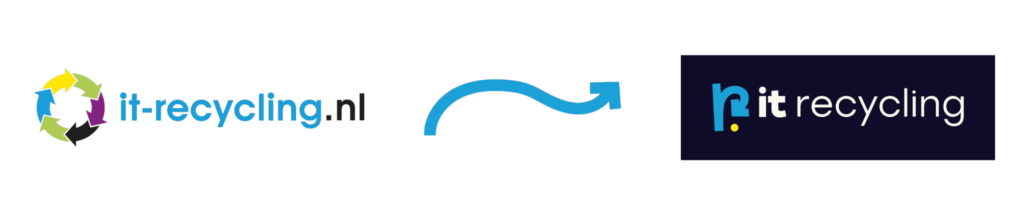
That idea is also reflected in our new logo. The old logo was a closed circle made up of four colored arrows: the universal symbol for recycling, and thus the symbol of an entire industry. Our name was included alongside it as a web address.
The new brand uses a single blue line. That line represents the path that IT takes through your organization and throughout the supply chain. It doesn’t loop endlessly, but always ends in an arrow—never open-ended. That’s the key difference: a circle keeps going, while a trail comes to a close. And you’ll receive proof of that closure.
IT Recycling has thus become a name rather than just an address.
What’s changing for you
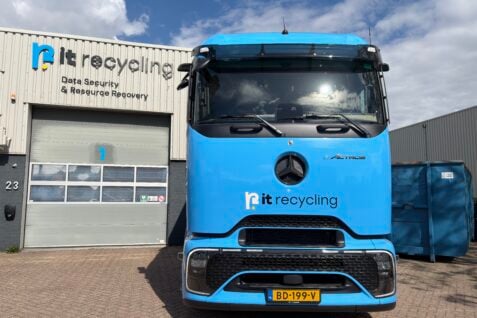
Nothing about the work itself will change. The same people, the same location in Veghel, the same drivers, the same certifications. You’ll call the same number, and the same truck will pull up.
What has changed is that you can verify our processes. The eight principles are documented, the supporting documents are available upon request, and the process is open for inspection. If you’d like to see how the hot and cold zones at our facility are separated from one another, you’re welcome to come take a look.
And if you’re currently working with another party, feel free to apply the eight principles to that collaboration. Can you provide documentation for the laptops written off from your last supplier—specifying where each device ended up, who handled the transport, and whether there’s a certificate listing the serial numbers? If the answer to any of those questions is missing, there’s a gap in the trail.
We’d be happy to help you figure that out.
Leave No Trace