




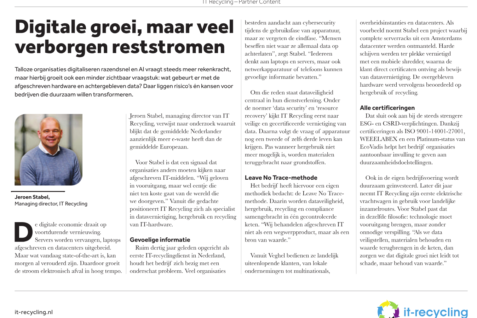
Data Destruction in the Spotlight: IT Recycling in the FD Supplement “AI Sovereignty & Data Science”
Data destruction is the featured topic in today’s “AI Sovereignty & Data Science ” supplement of *Het Financieele Dagblad*. In the article “Digital Growth, but Many Hidden Waste Streams,” Managing Director Jeroen Stabel explains why organizations that are rapidly digitizing often overlook one crucial phase: the end-of-life phase of their IT equipment. That is precisely where the greatest risks—and the greatest opportunities—lie.
Why Data Destruction Begins Where Digitization Ends
The digital economy runs on constant innovation. AI requires ever-increasing computing power, servers are being replaced, and data centers are being expanded. What’s state-of-the-art today may be obsolete tomorrow. As a result, the volume of decommissioned IT hardware is growing rapidly.
Research also shows that the average Dutch person produces significantly more e-waste than the average European. For Stabel, this is a sign that organizations need to take a different approach to their decommissioned IT assets.
Many organizations pay close attention to cybersecurity during the operational phase of their equipment but overlook the end-of-life phase. “People don’t realize where they’re leaving data behind,” Stabel says in the article. “Everyone thinks of laptops and servers, but network equipment and phones can also contain sensitive information.”
Secure data destruction using the Leave No Trace method
How do you ensure data security, reuse, recycling, and compliance all within a single process? Our answer is the Leave No Trace method: eight principles that together form a single, controlled chain—from certified data destruction to the maximum recovery of value and raw materials.
The process is clear. First, we focus on the secure and certified destruction of data. Next, we consider whether equipment can be given a second—or even a third—life. Only when reuse is no longer possible are materials returned to their raw material state.
“We don’t treat decommissioned IT as a disposable product, but as a source of value.”
On-site data destruction: from server rack to certificate
The article describes a striking example: a project in which entire server racks were dismantled from a data center in Amsterdam. Hard drives were destroyed on-site using a mobile shredder, after which the client immediately received certificates as proof of data destruction. The remaining hardware was then assessed for reuse or recycling.
For organizations handling sensitive data—from government agencies to data centers and multinational corporations—that is exactly what matters: no assumptions, but verifiable proof. No hassle afterward.
Certifications as the foundation for ESG and CSRD
This approach aligns with the increasingly stringent ESG and CSRD requirements. Thanks to certifications such as ISO 9001, ISO 14001, ISO 27001, and WEEELABEX—supplemented by a Platinum rating from EcoVadis—we help organizations demonstrably achieve their sustainability goals.
We’re also continuing to invest in our own operations. Later this year, we’ll be putting our first electric truck into service for nationwide collection routes. For Stabel, this aligns with our philosophy: technology should drive progress, but without unnecessary waste.
“If we secure data, conserve materials, and bring value back into the supply chain, we ensure that digital growth does not lead to harm, but rather to the preservation of value.”
Read the full article
The full article , “Digital Growth, but Many Hidden Waste Streams,” appears today in the ” AI Sovereignty & Data Science ” supplement of *Het Financieele Dagblad*.
Want to learn more about secure data destruction for your organization? Contact us—we’d be happy to work with you from the very beginning.
Frequently Asked Questions About Data Destruction
What is certified data destruction? Certified data destruction means that data storage media are destroyed in accordance with recognized standards (such as ISO 27001), with verifiable proof in the form of destruction certificates. This ensures that your organization demonstrably complies with laws and regulations.
Can data destruction take place at our own location? Yes. For high-risk data, we destroy data storage media directly on-site, in large volumes, using advanced shredders that meet the highest industry standard of 2 mm. The process is fully transparent and is documented in real time.
What happens to the hardware after data destruction? According to the Lansink Ladder, we strive to maximize the product’s lifespan, reuse parts, and recover high-quality raw materials—with a special focus on critical raw materials.